
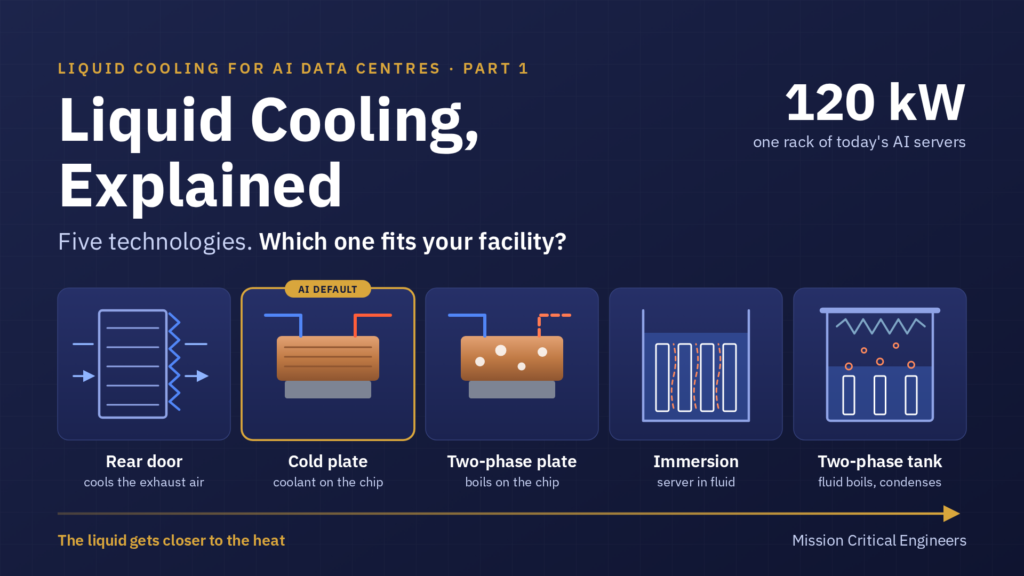
A single rack of today’s AI servers draws about 120 kW. Most data halls were built for racks that draw a fraction of that.
Choosing the technology is the easy part. Proving it works before the first AI rack depends on it is where projects succeed or fail.
At a glance
| Servers change? | Heat to liquid | Best fit today | |
|---|---|---|---|
| 1. Rear door | No | Nearly all of it, from the exhaust air; none at the chip | Existing halls, mixed hardware |
| 2. Direct-to-chip, single-phase | Cold plates fitted | Most (60–90%) | AI racks, new builds and retrofits |
| 3. Direct-to-chip, two-phase | Cold plates fitted | Most | Next-generation chips, early adopters |
| 4. Single-phase immersion | Approved for fluid, no fans | Nearly all | Edge, crypto, some HPC |
| 5. Two-phase immersion | Approved for fluid, no fans | Nearly all | Specialist; fluid supply in flux |
Why air runs out
For the same rise in temperature, a litre of water carries about 3,500 times more heat than a litre of air. Up to about 20 to 30 kW a rack, moving more air works. Beyond that, the fans, airflow and floor space stop making sense, and the chips now arrive designed for liquid: NVIDIA’s Vera Rubin NVL72 rack is 100 percent liquid-cooled.
Liquid cooling brings liquid closer to the heat. The closer it gets, the more heat it takes away, and the more the server has to change.
The five technologies, from the rack door to the whole server
1 Rear-door heat exchanger
A water-cooled coil replaces the rack’s back door and cools the servers’ exhaust air.
About the diagrams: illustrations for the concept, simplified to show how each technology works, not detailed designs. A real system adds the controls, valves, redundancy and safeties every site needs.
2 Direct-to-chip, single-phase
Coolant flows through a copper cold plate on each processor; a CDU pumps it and keeps it apart from the building’s water.
From the chip to the roof
3 Direct-to-chip, two-phase
A non-conductive refrigerant boils in the cold plate, like a kettle, and is condensed back to liquid in the CDU.
4 Single-phase immersion
Whole servers stand in an open tank of non-conductive fluid, under a lid; the fluid is pumped through a heat exchanger.
5 Two-phase immersion
Servers sit in a sealed tank of fluid that boils on the components and condenses on a coil under the lid.
Which one fits your facility?
| If you are… | Start with | What to prove before go-live |
|---|---|---|
| Adding a few dense racks to an existing air-cooled hall | Rear-door heat exchangers. No server changes; you need water at the rack. | Water above the dew point; the room holds with one door off |
| Building for current AI platforms | Single-phase direct-to-chip, with air or rear doors for the remaining heat. | A clean loop before servers connect; rides through a pump or CDU failure at full load |
| Running silent, fan-free compute at the edge | Single-phase immersion, if your floor and your hardware vendor allow it. | Floor loading; every part approved for the fluid |
| Planning for chips beyond about 2 kW | Keep two-phase direct-to-chip on the list; it is still early. | Leak-tight with the right charge; condenser holds at the warmest water |
| Considering two-phase immersion | Wait until the replacement fluids prove their supply and approvals. | Vapour stays in the tank; fluid supply secured |
The market has already chosen its default. Single-phase direct-to-chip leads the analysts’ splits, and TrendForce estimates liquid cooling at about a third of high-end AI infrastructure in 2025, rising past half in 2026.
Three things that change for the owner
There is still air. A liquid-cooled hall still needs air cooling (immersion far less of it) for the heat the liquid misses and for everything else in the room. Plan both systems, and how they interact.
Your data centre gains a plumbing system. Coolant chemistry, filtration, flushing and leak detection become daily operations. A loop that is dirty on day one fouls the cold plates; one that is not monitored corrodes slowly.
The time to react shrinks. When a coolant pump stops, the chip has seconds, not minutes, before it starts to throttle — so little that ASHRAE has opened research to measure it. Redundancy, controls, and proving them under load before handover, matter more than ever.
That last point is where the hard questions sit, and where this series goes next.
Next month: what happens in the seconds after a cooling failure, and how to prove the system rides through it.
Commissioning liquid cooling with Mission Critical Engineers
MCE commissions liquid-cooled AI data centres. We prove the loop is clean, the leak detection isolates and the system rides through a pump or CDU failure at full load, before the first rack depends on it.
Have a data centre project in planning?
Tell us about your project, and we will come back to you.
Send your project requestRelated Posts
Load Bank Testing in Data Centre Commissioning: Six Problems We See on Almost Every Project
Six load bank testing problems that derail data centre commissioning — generator tests that prove nothing, cooling validation that misses…
Read More »
Your data centre isn’t AI-ready. But it’s probably not as far as you think.
There is a number that should be on every data centre operator’s desk right now. It is the power density…
Read More »
Load Tap Changers: How Transformers Regulate Voltage Under Load
Data centres running AI workloads are among the most transformer-intensive facilities being built today — high-density loads, continuous operation, and…
Read More »