On this page
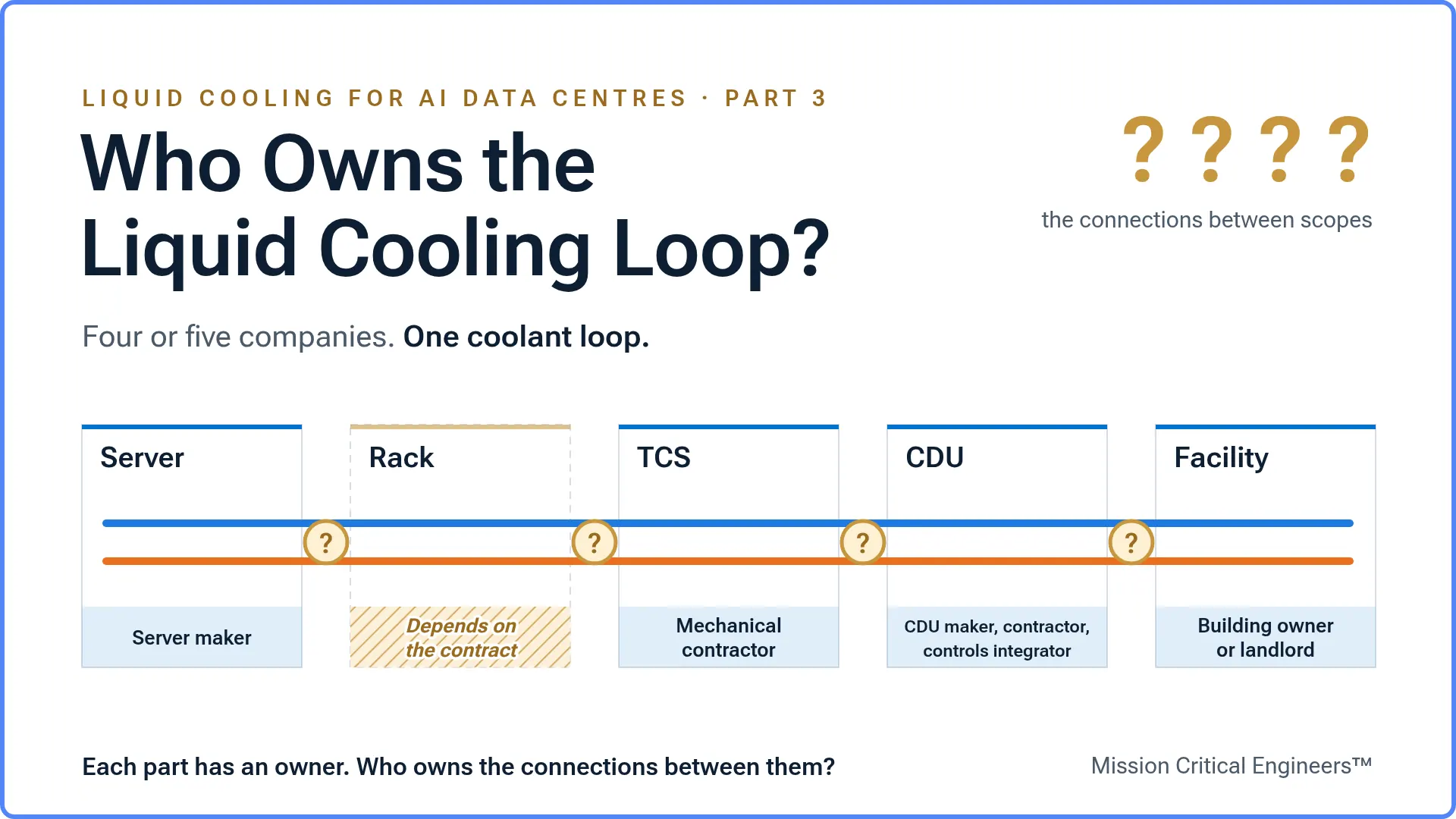
Each part usually has a clear owner. The loop as a whole often does not. The easiest way to see why is to follow the loop as it is built: who does what, in what order, and where one company hands over to the next.
In the last post we showed why a direct-to-chip hall has seconds, not minutes, when its cooling stops. This post looks at a question that comes before that one: when the loop has a problem, who is responsible for it? In an air-cooled hall the split was simple. The server ended at its fans, and the building looked after the air. A liquid cooling loop runs from inside the server to the roof.
In an air-cooled hall the split was simple. A liquid cooling loop runs from inside the server to the roof.
How the Loop Is Usually Split
At the chip
The cold plates inside the server belong to the server maker. They ship with the server and sit under its warranty.
In the rack
The rack manifolds and quick-disconnect couplings belong to the server maker, the rack integrator or the facility, depending on the contract. Often nobody is sure which.
The pipework to the racks
The pipework between the racks and the CDU, called the technology cooling system (TCS), is designed by the mechanical engineer and installed by the mechanical contractor. In a colocation hall it may be the tenant’s.
The CDU
The coolant distribution unit is supplied by its maker, installed by the contractor and connected by the controls integrator.
The facility side
The building’s cooling water, called the facility water system (FWS), belongs to the building: designed by the engineer of record and run by the facilities team for the life of the hall.
How the Loop Is Built, and Who Does What
The order varies from project to project, but on a typical project the loop goes in roughly like this.
- 01DesignThe engineer designs the building’s cooling water and the pipework to the racks, to suit what the server maker says its servers need. The servers themselves are often still being chosen.
- 02The cooling plantThe mechanical contractor installs the chillers or dry coolers and the building’s cooling water pipework.
- 03The CDUsThe CDU maker supplies the units, and the mechanical contractor sets them in place and connects them to the building’s water.
- 04The pipework to the racksThe mechanical contractor runs the pipework out to each rack position, checks it for leaks and cleans it out.
- 05The coolantThe loop is filled with the coolant the server maker asks for. Who fills it, and who supplies the coolant, varies.
- 06The controlsThe controls integrator connects the CDUs and the leak detection to the building’s control system.
- 07The racks and serversOften months later, the server maker or rack integrator brings in the racks and connects them to the pipework.
- 08Running as oneThe whole loop runs with the servers’ heat on it.
- 09HandoverThe facilities team takes over the loop and runs it for the life of the hall.
What Is at Stake
When something goes wrong with the loop, the first question is often whose part it was. A leak in a rack, a blocked cold plate or a CDU that cannot keep the coolant cool enough can take time to sort out between the companies involved, and the servers wait meanwhile.
Warranty is one place it matters. Server makers usually expect the coolant to be kept to their own standard. If nobody was in charge of the coolant from the start, that can be hard to show later. And at handover, the operations team takes on the loop as a whole, so someone needs to have checked it as a whole.
Where Responsibility Tends to Fall Through
The wait
The pipework is often finished and filled long before the racks arrive. Someone has to look after the loop while it waits, and it is often not clear who.
The last connection
The racks are connected by the last company to arrive, to pipework installed by a company that may already have left the site. That connection can end up in nobody’s test.
The coolant
The server maker says what the coolant must be, the contractor fills the loop, and the facility team runs it for years. Unless one party is in charge of the coolant from the start, it is easy for it to slip between them.
The controls and the leak alarms
The CDU, the servers and the building’s control system are set up by different people at different stages. Who answers a leak alarm, and who decides whether the servers keep running, is often not written down.
The first run as one
Each piece passes its own test along the way. The whole loop may first run as one system on the day the servers go live.
None of this tends to show in the contracts, because each one covers its own scope and its own stage. It usually shows when something goes wrong.
Every part of the loop, and every handover between companies, has a named owner. And the loop is tested as one system before the first server relies on it. A colocation hall needs extra care here: the lease sets a line between landlord and tenant, and that line falls somewhere along the loop.
Three Questions for Your Team
- Who looks after the loop between the coolant fill and the day the racks arrive?
- Who checks the connection when the racks are plugged in?
- Who has run the loop from the chip to the roof as one system?
If the answers differ, they are worth settling before construction.
How do you prove a liquid-cooled hall works before the servers arrive?
Related Posts
When Liquid Cooling Fails: The Seconds That Matter
When a coolant pump or CDU stops, the GPUs in a direct-to-chip liquid-cooled AI data centre have seconds. How the…
Read More »
Liquid Cooling, Explained: Five Technologies and Where Each Fits
Five liquid cooling technologies for AI data centres: rear doors, single- and two-phase cold plates, single- and two-phase immersion. What…
Read More »
Load Bank Testing in Data Centre Commissioning: Six Problems We See on Almost Every Project
Six load bank testing problems that derail data centre commissioning — generator tests that prove nothing, cooling validation that misses…
Read More »