Insights from Mission Critical Engineers on data centre commissioning, power systems and mission-critical electrical engineering.
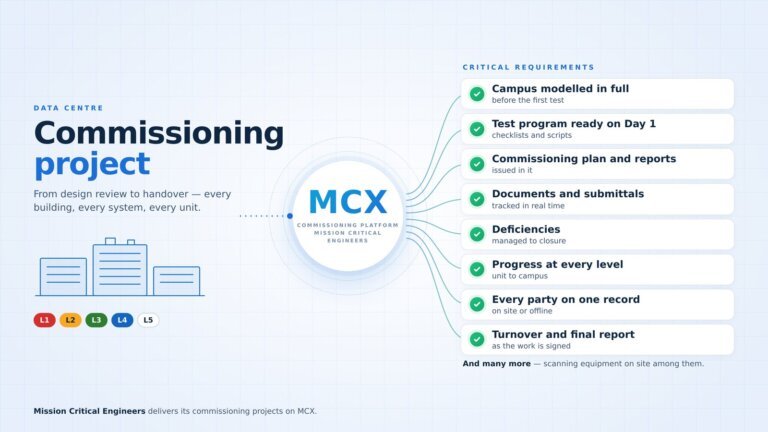
Before anything is tested, a commissioning project needs a team that knows how these facilities fail, the owner's requirements, a commissioning plan, design reviews and a test for every piece of equipment. The team is ours. The rest is MCX.
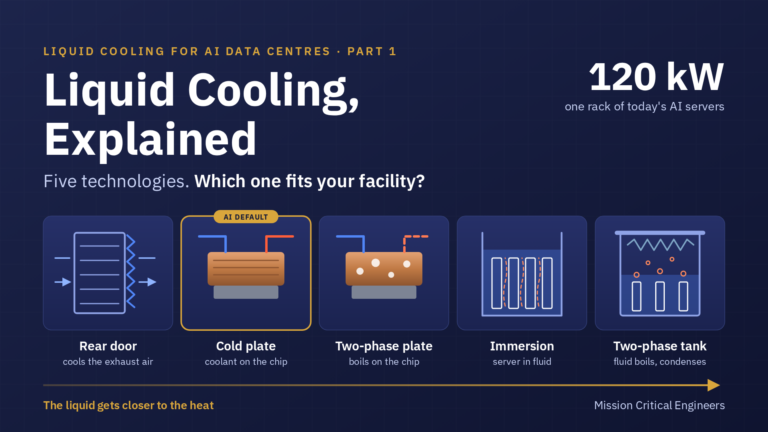
Five liquid cooling technologies for AI data centres: rear doors, single- and two-phase cold plates, single- and two-phase immersion. What each is, where it fits, and what commissioning must prove before the first rack depends on it.

Six load bank testing problems that derail data centre commissioning — generator tests that prove nothing, cooling validation that misses hot spots, and an IST deadline nobody is protecting. If two feel familiar, let's talk.

Vendor start-up proves each piece of equipment in isolation. An independent commissioning authority proves the facility works as one integrated system, and checks what self-witnessed IST scripts miss.

AI-ready is not a certification. It is a set of thresholds across five systems (power density, structural load, cooling, network and fiber density, and monitoring), and an assessment shows which of them have headroom before any capital is committed.

How on-load tap changers regulate transformer voltage under load: the turns ratio, the two-stage switching sequence, resistor, reactor and vacuum transition elements, and what the mechanism means for maintenance and condition monitoring.

As AI data centres deploy hundreds of medium-voltage transformers, electrical protection has shifted from a substation specialty to mission-critical infrastructure design. Explore the complete transformer protection stack and the engineering mechanics of the 87T differential relay.

How a UPS bridges the gap to backup power, how a double-conversion UPS behaves in online, battery and bypass mode, and how static, flywheel, hybrid and DRUPS architectures compare.

Feeders and cables are the most vulnerable assets in a mission-critical facility. Four tests go beyond code-minimum commissioning: advanced insulation diagnostics, conductor and connection integrity, ground fault protection validation, and load performance under real operating conditions.
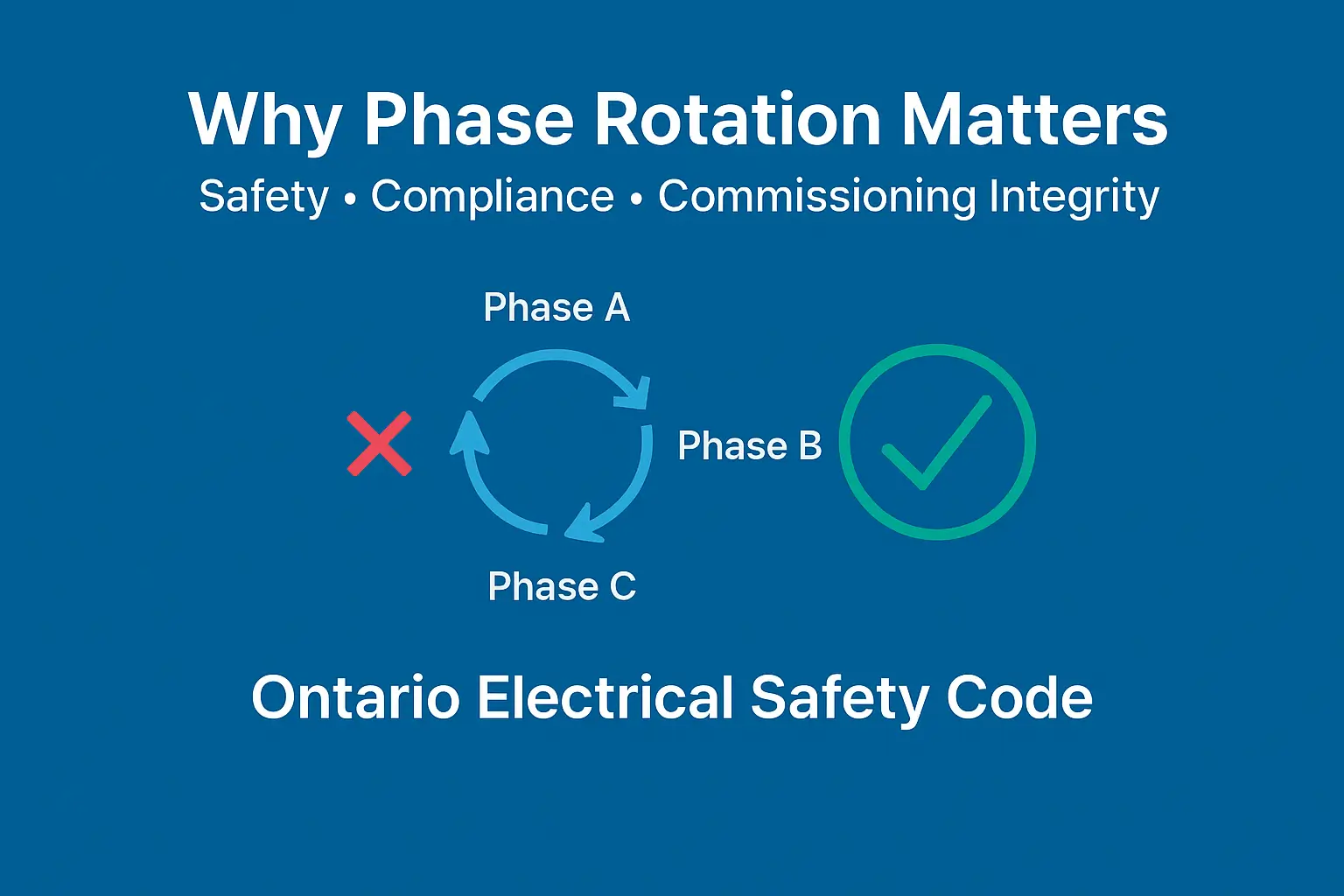
A technical white paper on phase rotation in three-phase systems in Ontario: the principles, a risk hierarchy of equipment, the OESC provisions that apply, a five-part field verification process, and the economic and legal stakes.

Racks drawing 50kW, 70kW or more introduce failure points that standard assessments can't account for. Three questions on cooling, power distribution and heat rejection to answer before you scale a high-density GPU deployment.

How a generator works, kW vs kVA, the difference between standby, prime and continuous duty ratings, derating for temperature and altitude, and how to select a generator.

Copper and aluminum conductors compared, and the common electrical conductor types by insulation, configuration, environmental rating and ampacity, with typical applications for each.
Tell us about your project, and we will come back to you.
